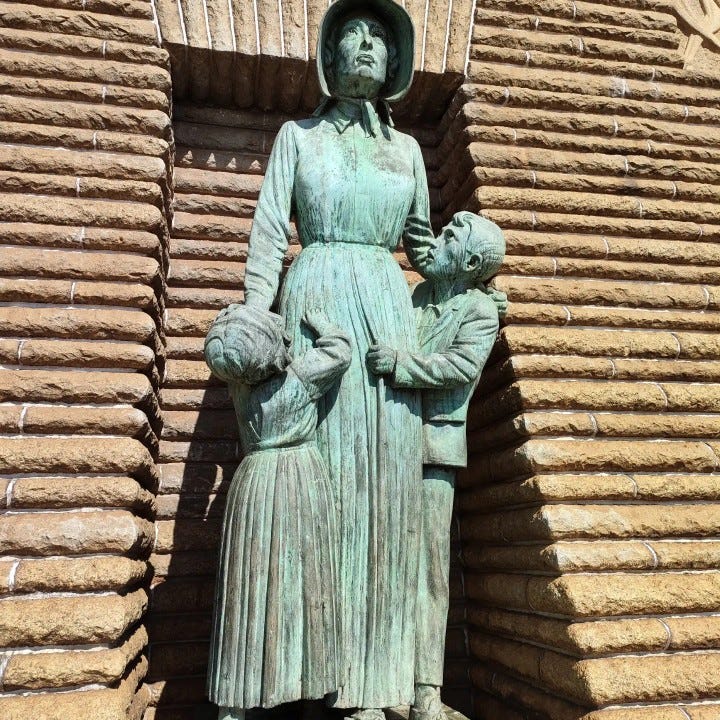
From Wagons to Stone.
The Groot Trek and the Making of Political Authority in Southern Africa.

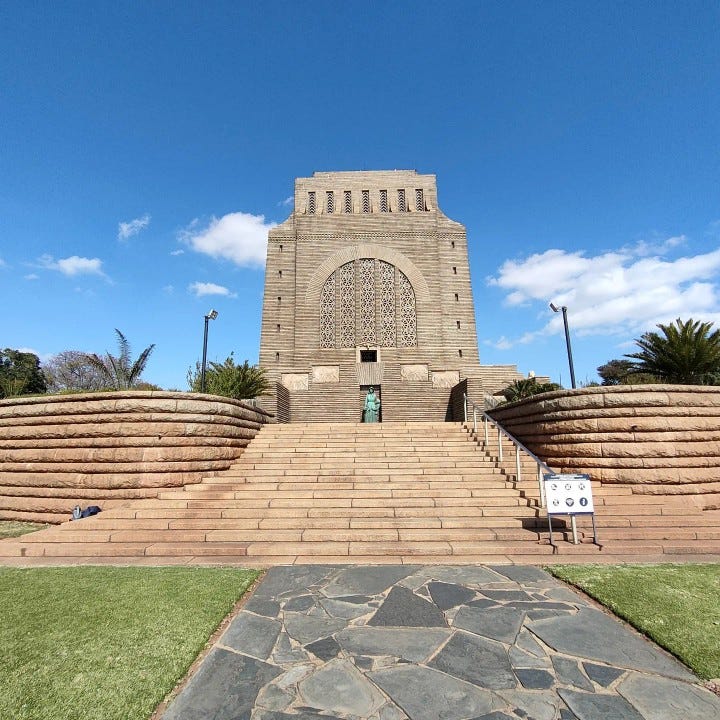
The Voortrekker Monument is not the beginning of the Great Trek. It is its resolution.
Everything uncertain, fragmented, and unresolved about the nineteenth-century migrations that came to be called the Groot Trek is flattened here into geometry, marble, and ritual. What was once movement becomes permanence. What was once argument becomes stone certainty. The monument does not ask what happened. It tells you what it means.
To understand why such certainty was needed, one must return to a world in which authority was unstable, borders were negotiable, and political legitimacy had not yet been decided.
I. Leaving the Cape: Empire, Law, and the Limits of Autonomy
By the early nineteenth century, the Cape Colony had ceased to be a frontier in the old sense. British imperial administration was no longer distant or episodic; it was systematic. Courts expanded their reach, English gained institutional dominance, and colonial law increasingly replaced older Dutch legal traditions. For many Dutch-speaking farming communities, the change was not merely administrative. It was existential.
The abolition of slavery within the British Empire accelerated this sense of rupture. While morally inevitable in hindsight, abolition arrived through bureaucratic mechanisms that many farmers experienced as hostile or inadequate. Compensation schemes were slow, distant, and entangled in imperial finance. Labour systems that underpinned agricultural life collapsed without local alternatives ready to replace them.
More destabilising still was the erosion of local autonomy. The frontier farmers of the eastern Cape had long lived in a grey zone between state oversight and self-regulation. British governance narrowed that space. Decisions increasingly flowed from Cape Town and London, not from local commandos or communal assemblies.
The decision to leave was therefore framed not simply as migration, but as political withdrawal. To trek was to step outside imperial law and attempt to rebuild authority elsewhere.
This distinction matters. The Great Trek was not a mass exodus driven by desperation alone. It was an assertion that legitimacy could be relocated.
II. Fragmented Routes, Competing Leaders, and Geography as Politics
The phrase “Great Trek” conceals a fundamental truth: there was no single trek.
Between the mid-1830s and early 1840s, multiple groups departed the Cape independently, led by figures with different ambitions, temperaments, and political assumptions. Louis Trichardt pushed far north toward the Limpopo, entering disease-ridden lowlands that decimated his party. Hendrik Potgieter favoured the Highveld, pursuing land and autonomy through force and strategic alliances. Piet Retief turned east toward Natal, convinced that treaties and diplomacy could secure legitimacy.
These were not merely routes. They were political experiments.
Geography shaped authority. The Highveld offered grazing and strategic depth but exposed trekkers to conflict with powerful African polities. Natal promised access to the sea and fertile land but required negotiation with established sovereignty. The far north offered isolation but little margin for survival.
Fragmentation weakened collective bargaining power but allowed flexibility. Trekker parties split, merged, argued, and separated again. Leadership was provisional, earned through persuasion and military competence rather than inherited command.
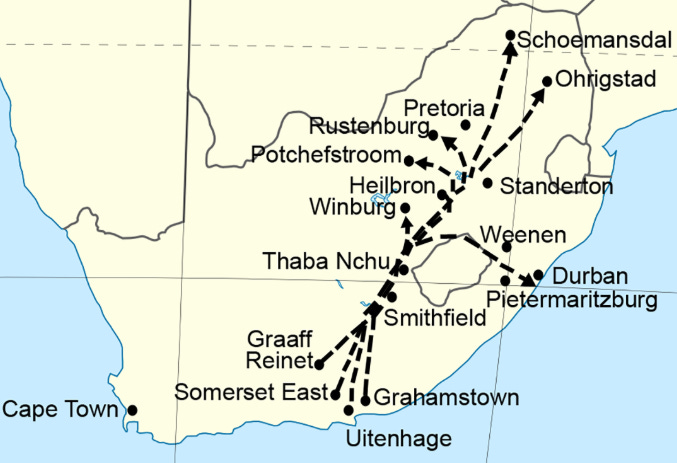
Maps matter because they reveal choice. There was never a unified destination, only a series of calculated risks taken by groups seeking political space beyond imperial reach.
III. Sovereignty on the Highveld: Conflict, Cattle, and Command
Beyond the Cape’s borders, trekkers encountered not emptiness, but competing sovereignties.
The Highveld had already been reshaped by earlier upheavals. Political authority rested with African leaders whose power derived from land control, military organisation, and alliance networks. Among the most formidable was Mzilikazi, whose Ndebele polity exercised real territorial command.
Conflict was not accidental. It emerged from incompatible claims to authority.
The clash at Vegkop in 1836 is often remembered as a defensive victory. In political terms, it was something else: a test of whether mobile settler communities could survive without formal state backing. The laager was not merely a defensive formation. It was an improvised political institution, a temporary state organised around wagons, firearms, and discipline.


Cattle losses mattered more than battlefield outcomes. Livestock powered wagons, fed families, and signalled wealth. To lose cattle was to lose sovereignty in practical terms. Violence therefore escalated not out of ideology, but necessity.
The Highveld campaigns revealed a hard truth: autonomy required coercive power. Negotiation alone could not secure land where authority was already claimed.
IV. Natal: Diplomacy, Treaty Failure, and the Collapse of Political Assumptions
If the Highveld represented coercion, Natal represented negotiation.
Retief’s movement into Natal rested on the belief that land could be secured through treaty. The assumption was that written agreements, understood through European legal traditions, could translate across political systems.
That assumption proved fatal.
Negotiations with Dingane, ruler of the Zulu kingdom, unfolded within radically different conceptions of authority. Where trekkers sought permanent settlement rights, Dingane operated within a political framework that treated land, allegiance, and permission as conditional and revocable.
Retief’s killing in 1838 was not simply betrayal. It was the violent collapse of incompatible political languages.
What followed was not inevitable retaliation, but escalating state formation through violence. The massacres of trekker families hardened resolve and eliminated any remaining faith in diplomacy. When Andries Pretorius assumed command, legitimacy would be sought not through treaties, but victory.
The Battle of Blood River was therefore more than a military encounter. It functioned as a founding myth of political authority. The vow made before the battle fused theology and governance, presenting victory as divine endorsement.

That fusion of faith and force would echo for generations.
V. Republics, Recognition, and the Language of Empire
Victory in Natal did not secure independence.
The short-lived Natalia Republic revealed the limits of settler sovereignty in the face of imperial power. British annexation in 1843 reasserted colonial authority and forced many trekkers to move again.
But this time, the strategy changed.
Rather than resisting empire outright, settler leaders pursued recognition. The Sand River Convention of 1852 and the Bloemfontein Convention of 1854 formalised limited independence north of the Vaal and between the Orange and Vaal rivers.
These were not acts of liberation. They were negotiated compromises.
Britain retained strategic oversight while offloading administrative burden. Settler republics gained legitimacy but accepted constraints. Slavery was formally prohibited, though enforcement varied. Political authority was recognised, but never absolute.
This was the moment when movement hardened into statehood.
The Trek’s true legacy lies less in battles than in these documents. Treaties, not wagons, shaped the future.
VI. From Movement to Memory: Why the Trek Needed Stone
By the twentieth century, the Great Trek had become more than history. It became origin.
Afrikaner nationalism required clarity. Fragmentation had to be erased. Political compromise had to be recast as destiny. Violence had to become sacrifice.
The Voortrekker Monument answered these needs.
Its architecture mirrors treaty logic. Thick walls. Closed forms. No ambiguity. The frieze replaces debate with sequence. The cenotaph ritual fixes meaning in time.


Built as apartheid became formal policy, the monument did not simply commemorate the past. It justified a political present.
Today, it stands in dialogue with Freedom Park, representing a different vision of memory: plural, unfinished, contested. Between them lies the unresolved question of South African history itself.
The Great Trek was never one journey. It was a struggle over authority: who could rule, who could claim land, who could write law.
Stone tried to settle that argument.
History did not.